BJFe Fuzz 66 – Rare, Versatile and Purely Musical
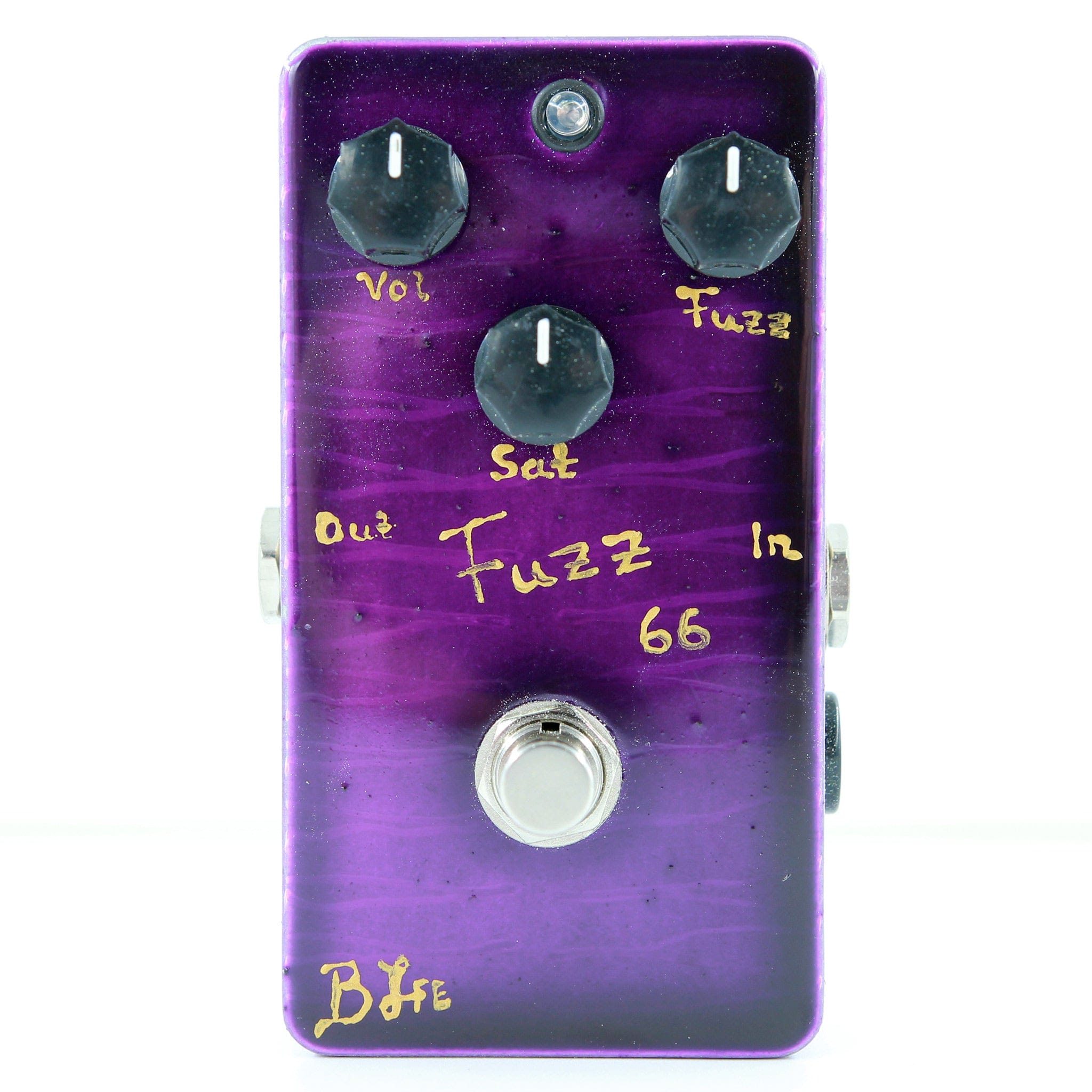
The BJFe Fuzz 66 (F66) is an exceptionally versatile germanium fuzz that combines elements of the classic Fuzz Face and Tone Bender sounds with Björn Juhl’s unmistakably musical approach to circuit design.
With a simple adjustment of the Saturation control, the Fuzz 66 moves from smooth, warm and responsive vintage fuzz to a more aggressive sound with rich harmonics and plenty of bite. It reacts beautifully to your guitar’s volume control and playing dynamics, making it far more expressive than a typical one-sound fuzz pedal.
Inspired by a Particularly Great Fuzz Face Sound
The inspiration came partly from a video of a guitarist playing an unusually great-sounding red Fuzz Face. Several people sent Björn the same clip within a very short period, all asking the same question: Why does this one sound so much better than the others?
The obvious answer was, of course, that it was red—and everyone knows that red Fuzz Faces sound better. But there was also a more technical explanation.
In the video, the guitar’s volume control appeared to be set around eight and the player was using a coiled cable. Together, the guitar’s volume control and the cable capacitance created a natural low-pass filter, gently removing some of the harsh upper-frequency edge. The circuit may also have presented a slightly different input load, tightening the bass just enough to prevent the sound from becoming overly soft or muddy.
Designed Around the Transistors
A great germanium fuzz cannot be created simply by downloading a vintage schematic, inserting two expensive transistors and expecting magic. Germanium transistors vary considerably, and the familiar component values found in old schematics are no guarantee that a particular pair will sound—or even function—as intended.
Björn instead selected excellent germanium transistors and adapted the circuit around their individual characteristics. The operating points of both transistors were carefully set for the most musical response, while the input and frequency filtering were tuned to retain everything desirable and remove only what was unnecessary.
With the component values hidden, the circuit would still clearly resemble the classic Fuzz Face topology. However, virtually none of the surrounding values are simply copied from a standard online schematic. Every part of the design is chosen to make these specific transistors perform at their best.
Two Rare NOS Germanium Transistors
This particular Fuzz 66 is built with two rare NOS General Electric oval top-hat germanium transistors. They provide a rich, dynamic response with excellent touch sensitivity, musical compression and the complex harmonic texture associated with the finest vintage fuzz pedals.
The result is full and saturated without turning into undefined low-frequency mush. The top end has clarity and bite without the unpleasant fizz that can make some germanium fuzz pedals difficult to use.
Vintage Character, Refined by Björn Juhl
The Fuzz 66 captures the personality of two of the most iconic fuzz families ever made, but it is not intended as a component-for-component reproduction. It is Björn Juhl’s interpretation of what makes those exceptional vintage examples so compelling—and an attempt to make that sound responsive, balanced and genuinely useful.
- Hand-built in extremely limited quantities
- Two NOS General Electric oval top-hat germanium transistors
- Carefully optimised transistor operating points
- Voicing inspired by exceptional vintage Fuzz Face tones
- Elements of both Fuzz Face and Tone Bender character
- Saturation control for a wide range of fuzz textures
- Excellent response to guitar volume and playing dynamics
- Rich harmonics with controlled bass and a smooth top end
The BJFe Fuzz 66 is not merely another copy of a vintage fuzz circuit. It is a carefully tuned instrument built around two exceptional germanium transistors and refined by one of the world’s most respected analogue pedal designers.


%20is...)